Author: Dr. Hootan Zandifar, Medical Director, FUEsion Hair Clinics
Co-Author: Dr. Michael Wisiorek, Board-Certified Surgeon, FUEsion Hair Clinics
If you’re searching for the best hair transplant Denver, you’re probably dealing with more than thinning hair—you’re looking for confidence, a natural-looking hairline, and a clinic that treats your results like a medical outcome and an art form. At FUEsion Hair Clinics, we help patients across the Denver area understand what actually drives success in modern follicular unit extraction (FUE) and why “best” should be defined by measurable quality, not marketing alone.
In this guide, we’ll break down how to evaluate clinics in Denver, what questions to ask at your consultation, and how advanced AI & AR-assisted FUE planning can support natural density and long-term satisfaction.
Why “best hair transplant denver” is different for every patient
There isn’t one universal “best” approach. The right hair transplant plan depends on your hair loss pattern, donor hair availability, scalp characteristics, expectations, and how you want to look at 12–18 months (not just immediately after surgery).
In Denver, local patients often want a hairline that suits their face shape and lifestyle—whether they’re active outdoors, prefer lower maintenance routines, or want results that blend seamlessly with existing hair. That’s why we focus on personalized planning, strict surgical protocols, and careful graft distribution.
What makes a Denver hair transplant truly “top-tier”
When patients ask us for the best hair transplant Denver, we guide them to evaluate three pillars:
- Surgeon-led technique and micro-precision (not technician-driven shortcuts)
- Graft survival and preservation (extraction geometry, processing protocols, implantation depth/angle)
- Design artistry (natural hairline shape, density distribution, and realistic coverage goals)
How we define “best” at FUEsion Hair Clinics
At FUEsion Hair Clinics, “best” means you can expect consistent, surgeon-guided standards across every stage of the procedure. We combine advanced planning support with our proprietary surgical technique so patients can move forward with clarity and confidence.
Advanced AI & AR-assisted FUE planning for precision
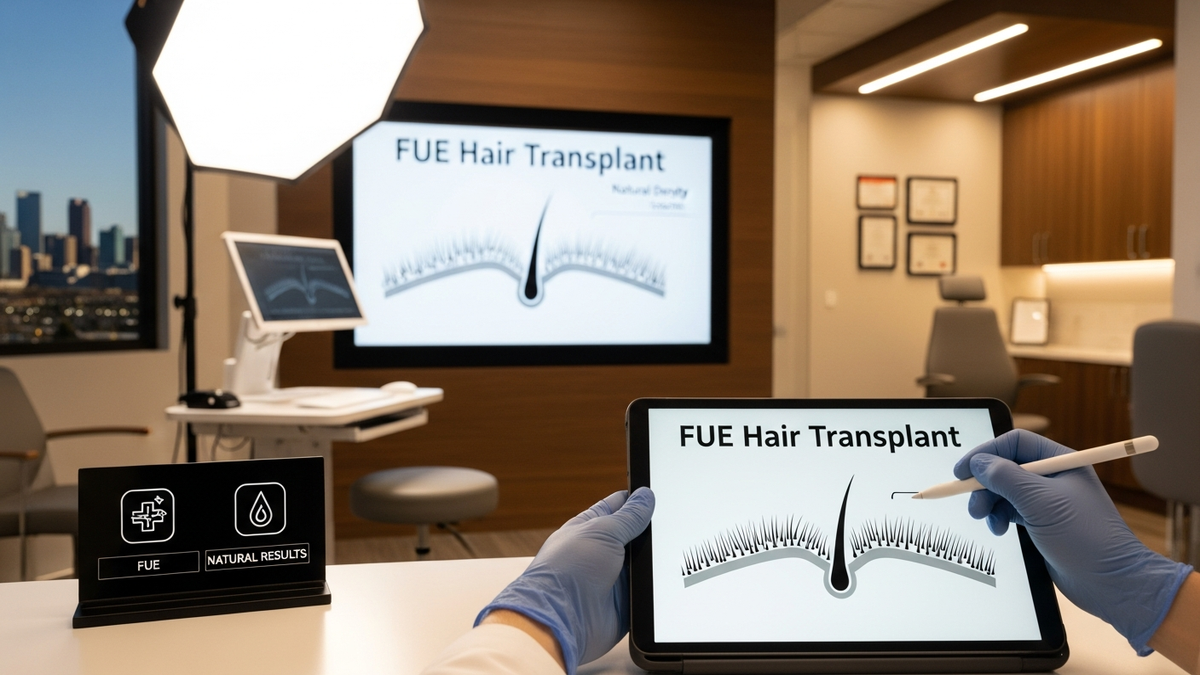
Modern hair restoration is not only about extracting grafts—it’s about optimizing the entire workflow. Our AI & AR-assisted approach supports improved decision-making across follicle assessment, extraction geometry, and implantation strategy. That matters because small technical details can influence the appearance of the hairline and how dense and natural the result looks over time.
Surgeon-led procedures, not assembly-line care
We perform every step of the FUEsion technique under strict protocol by our board-certified surgeons. Patients deserve to know who is making the critical calls: donor assessment, extraction mapping, and graft placement.
Graft survival and natural density as the goal
Hair transplant outcomes depend on preserving graft quality and placing grafts in a way that supports natural growth. In our practice, we emphasize minimizing trauma during extraction and maintaining careful handling through processing and implantation.
Denver patients: what to look for in the best hair transplant clinics
When you compare clinics in Denver, focus on evidence of process quality. Here’s a checklist you can use during calls, in-person visits, or virtual consults.
1) Surgeon credentials and actual procedure responsibility
Ask who performs each step. A premium clinic should be transparent about whether the surgeon personally performs donor assessment and graft placement. If the clinic can’t clearly explain surgeon involvement, that’s a red flag.
2) Donor assessment quality (microscopic evaluation)
Your donor region determines your potential. The best hair transplant Denver options conduct a detailed donor analysis to map follicular units and plan extraction in a way that preserves donor appearance and supports future coverage needs.
3) Extraction geometry and transection minimization
Graft transection rates are a key factor in graft quality. Ask how extraction tools are selected and calibrated for each patient and whether the clinic uses a protocol designed to minimize trauma.
4) Implantation depth, angle, and hairline artistry
A natural hairline depends on correct angle and direction. The best hair transplant Denver plans also account for how hair grows in your specific scalp region and how your hairline frames your facial features.
5) Transparent expectations: timeline and realism
Hair restoration is a process, not an overnight change. You should receive a clear timeline for visible improvement and full results—typically around 12–18 months for final density and maturation.
6) Follow-up care and support
Strong post-procedure follow-up helps you manage healing, medication guidance (when applicable), and progress monitoring. A clinic that disappears after surgery is not the best choice for long-term satisfaction.
What advanced hair transplant technology should include
Technology is only valuable when it improves surgical planning and execution. For Denver patients, we recommend asking clinics how their tools support measurable outcomes—especially around assessment, planning, and placement.
AI & AR-assisted FUE: what it can (and can’t) do
AI and AR planning support can help visualize and refine hairline options, estimate graft needs, and guide planning decisions. However, it does not replace medical evaluation. The final design must always be confirmed by a surgeon based on your anatomy and donor characteristics.
If you’d like to explore planning before your visit, you can use our AI Result Simulator to preview hairline and density possibilities.
Graft estimation and cost planning tools
We believe patients should feel informed, not pressured. A quality clinic should offer clarity on how graft counts are estimated and what factors affect your plan. You can also review our Cost Calculator to understand how graft quantity and coverage goals influence planning.
FUE vs other hair restoration options: who benefits most?
Many people searching for the best hair transplant Denver are also comparing FUE to other methods. The right solution depends on your hair loss pattern and donor quality.
Who FUE (including AI & AR-assisted FUE) is best for
FUE is often a strong option for patients with androgenetic alopecia (male pattern hair loss) who have sufficient donor density. It’s also commonly chosen by patients who want to avoid linear scarring and prefer minimal downtime.
When non-surgical restoration may be considered
Some patients aren’t ready for surgery or want to address early thinning. Non-surgical restoration may be considered depending on your diagnosis and goals. At FUEsion Hair Clinics, we offer Non-surgical Hair Restoration options as part of a broader strategy—always guided by clinical evaluation.
To compare options by service line, you can explore Hair Transplant Procedure and related offerings.
Denver hair transplant timeline: what to expect, step by step
Knowing the timeline helps you plan work, travel, and expectations. Below is a typical process outline for AI & AR-assisted FUE hair transplant care.
Before surgery: assessment, planning, and graft mapping
During your consultation, our surgeons evaluate your pattern of hair loss, donor characteristics, and desired coverage. We then design a plan that considers hairline design, density distribution, and long-term strategy.
Day of procedure: extraction and implantation
Our team follows strict protocols for extraction and implantation. Patients typically receive local anesthesia and remain comfortable and awake during the procedure.
Early healing: days 1–7
In the first week, you can expect healing and initial shedding patterns that are normal in many cases. Many patients plan for a return to work around 5–7 days, depending on their individual response and job demands.
Growth phase: months 3–6
Visible improvement often begins around 6 months as grafts enter growth and maturation. Your results will continue to evolve over time.
Full results: 12–18 months
Final density, texture, and hairline integration are typically evaluated at 12–18 months. This is when many patients feel the most confident about the outcome.
How we approach natural hairline design for Denver faces
Natural hairline design is where artistry meets anatomy. The “best hair transplant Denver” results don’t look like a hairstyle—they look like your hair grew that way.
Hairline shape, density, and age-appropriate design
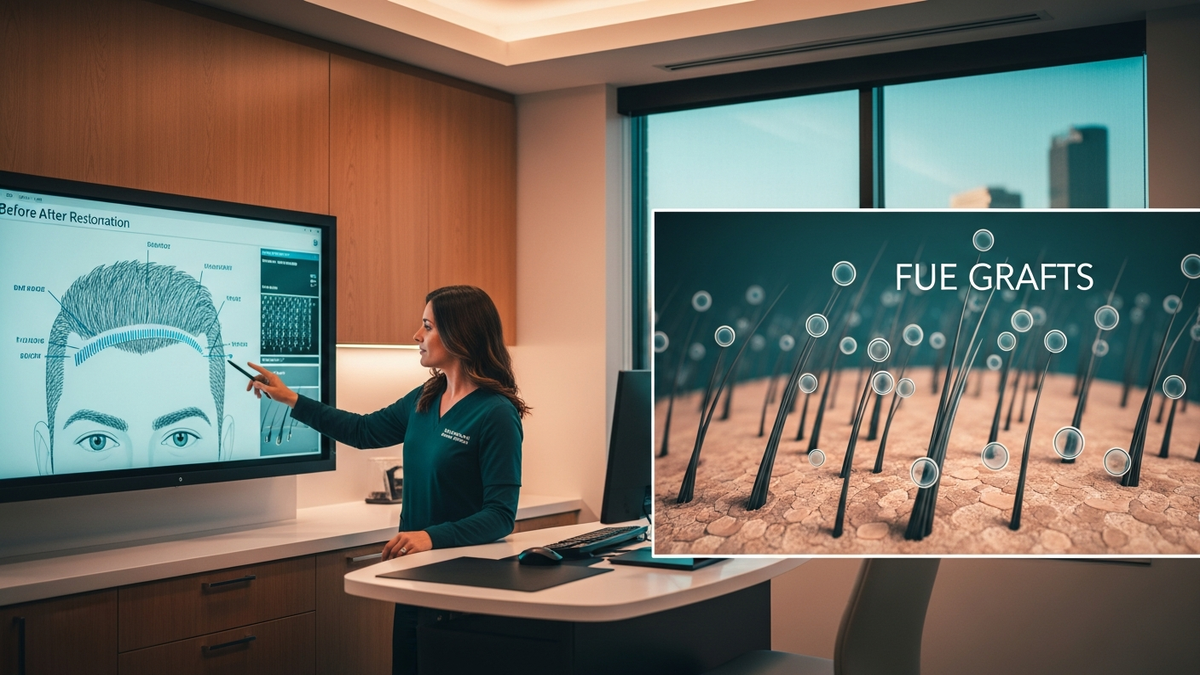
We design hairlines that complement your facial proportions, taking into account your current density, recession pattern, and how you expect to style your hair. Density distribution is equally important: the front hairline often requires careful planning to avoid an unnatural “overbuilt” look.
Temple recession and crown thinning planning
Many Denver patients present with temple recession and crown thinning. A premium plan balances coverage goals across regions so the result looks cohesive rather than patchy.
Additional restoration: beard, eyebrows, and female hair transplant
Hair restoration isn’t only about the scalp. Some patients want to restore facial hair definition, eyebrow framing, or address traction-related or hormonal thinning.
Beard transplant for definition and symmetry
If you’re looking for beard enhancement or fuller growth patterns, explore Beard Transplant. We focus on natural direction and density to match your facial features.
Eyebrow transplant for shape and balance
Eyebrows frame the face. Patients interested in eyebrow restoration can review Eyebrow Transplant for a surgical approach designed to respect natural growth patterns.
Female hair transplant for thinning and density restoration
Female hair transplant planning requires careful design and a sensitive approach. If you’re exploring options, review Female Hair Transplant to understand how we approach density restoration for women.
Before and after expectations: what to review (and what to ask)
When you look at Hair Transplant Before and After examples, don’t only evaluate the final look. Ask how the clinic achieved consistency across different hair loss patterns and how they manage cases with limited donor supply.
Questions to ask about results quality
- How do you design density distribution across the hairline and mid-scalp?
- What is your approach to extraction mapping and minimizing graft trauma?
- How do you handle varying donor characteristics?
- What does follow-up care include through the first year?
Premium clinics should answer these clearly and confidently—with details, not vague promises.
FUEsion Assurance: peace of mind for Denver patients
We know that choosing the best hair transplant Denver is a high-stakes decision. That’s why we offer FUEsion Assurance/Warranty to support patient confidence and accountability.
Insurance-like coverage can vary by clinic and by individual situation. During your consultation, we’ll explain what the assurance includes, the expectations for outcomes, and how we monitor progress so you’re never left guessing.
Denver hair transplant costs: what influences price the right way
Cost is important, but it shouldn’t be the only factor. A lower price can be misleading if it corresponds to fewer grafts, less surgeon time, or reduced planning detail. Instead, evaluate cost in relation to graft count, coverage goals, and the quality of execution.
Key factors that affect your plan
- Graft count: based on your hair loss stage and how much coverage you want
- Donor quality: affects how many high-quality grafts can be safely used
- Hairline complexity: natural design often requires nuanced distribution
- Timeline expectations: realistic growth and maturation planning
If you want to estimate planning factors before meeting with a surgeon, use our Cost Calculator for a starting point.
Statistics and evidence that matter in hair transplant outcomes
Patients often ask us what the evidence says about graft survival and technique. While every case is individual, scientific literature and clinical outcomes help us focus on what truly matters.
Graft survival is a central quality metric
According to a review in the Journal of Cutaneous and Aesthetic Surgery, graft survival and minimizing transection are critical determinants of successful FUE outcomes (source: PubMed Central—search: “FUE graft survival transection review”).
Technique and handling influence outcomes
According to the International Journal of Trichology, the quality of follicular unit handling and implantation parameters can influence long-term growth outcomes (source: PubMed Central—search: “trichology follicular unit extraction implantation parameters”).
What this means for Denver patients
These findings reinforce why the best hair transplant Denver options prioritize micro-precision—especially extraction geometry, careful processing, and correct implantation depth and angle—rather than relying solely on “number of grafts” or promotional claims.
Note: Exact survival rates vary by patient anatomy, technique, and evaluation methods. Your surgeon should review your specific case and expectations.
Who should book a consultation (and when)?
You should consider booking a consultation if you’re experiencing progressive thinning, receding temples, or crown loss that affects your confidence. If you’ve tried non-surgical approaches and want a structural change, a surgeon-led plan can clarify whether you’re a strong candidate for FUE.
Ideal timing for planning
If you’re in the early-to-mid stages of hair loss, you may have more flexibility in designing coverage that looks natural over time. However, even later-stage patients can sometimes benefit depending on donor quality and realistic goals.
To start your planning journey, you can explore clinic information and consult pathways via FUEsion Hair Clinics Denver.
How to prepare for your Denver hair transplant consultation
To get the most value from your appointment, we recommend preparing a few key items and questions.
Bring relevant medical and hair loss history
Include details about when your hair loss started, any medications you’ve used, and any prior treatments. If you have family history, share that as well—pattern recognition helps with planning.
Decide what “success” means to you
Success might mean a natural hairline, improved density in the front, or better coverage on the crown. Bring photos if possible (especially if you want your surgeon to align on hairline shape).
Ask the right questions
- How many grafts might I need, and why?
- What is your approach to hairline design and density distribution?
- Who performs extraction and implantation?
- What timeline should I expect for visible improvement and full results?
- How does FUEsion Assurance/Warranty apply to my case?
Local guidance: Denver weather, lifestyle, and recovery planning
Denver’s lifestyle—outdoor activity, altitude considerations, and seasonal swings—can influence comfort during recovery. While your surgical plan is medical, your post-procedure routine matters.
Recovery-friendly planning tips
- Plan downtime around the first week for healing and comfort.
- Follow all post-op instructions carefully, including gentle scalp care.
- Ask your surgeon about timing for exercise and sun exposure.
- Use your clinic’s follow-up schedule to monitor progress.
At FUEsion Hair Clinics, we guide patients on what to expect in the days and months after surgery so you can plan confidently.
Frequently Asked Questions
How do I know I’m choosing the best hair transplant Denver clinic?
The best clinic is transparent about surgeon-led care, graft planning, and realistic timelines. Ask how extraction mapping is performed, who performs implantation, and what follow-up support looks like through the first year.
Is FUE the same as “best hair transplant”?
FUE is a technique, but “best” depends on how it’s executed—assessment quality, extraction geometry, graft handling, and implantation strategy. A premium FUE clinic should explain these details clearly during consultation.
What timeline should Denver patients expect after an FUE hair transplant?
Many people see initial improvement around 6 months, with fuller results typically at 12–18 months. Growth is gradual, so it helps to plan emotionally and practically for a longer transformation.
Can I use an AI simulator before booking my consultation?
Yes—tools like our AI Result Simulator can help you visualize hairline and density options. However, your surgeon must confirm your plan based on your anatomy and donor characteristics.
Will a hair transplant look natural for my hair type and face shape?
Natural results depend on hairline design artistry and correct implantation angles and direction. During your consultation, we design a plan that considers your facial features, hair growth patterns, and realistic coverage goals.
Ready to choose your best hair transplant Denver plan?
If you want a surgeon-led approach to FUE hair restoration—with advanced planning support, careful micro-precision, and accountable patient care—our team is ready to help.
We invite you to start with a consultation so we can evaluate your donor region, discuss your goals, and outline a clear plan for next steps.
Prefer to explore first? Learn more about About FUEsion Hair Clinics and review our FUEsion Hair Clinics Locations to understand where care is available.

Professional Disclaimer
This content is provided for general educational purposes only by FUEsion Hair Clinics. It is not a substitute for professional advice, diagnosis, or treatment. Readers are advised to consult qualified professionals for personalized recommendations.
Medical Information Disclaimer
This content is provided for general educational purposes only by FUEsion Hair Clinics. It is not a substitute for professional advice, diagnosis, or treatment. Readers are advised to consult qualified professionals for personalized recommendations.