OG Title: Hair Implant Surgeon Guide: FUE vs FUT & Recovery
OG Description: Learn how to choose a hair implant surgeon, compare FUE vs FUT, and understand graft planning, risks, and recovery. Book a consult.
Hair loss can affect confidence, identity, and day-to-day comfort—so it’s natural to search for a hair implant surgeon you can trust. Whether you’re exploring FUE, FUT, or a combination approach, the best results typically come from a surgeon who plans grafts precisely, prioritizes donor safety, and manages expectations with evidence-based guidance.
In this guide, you’ll learn who should consider hair transplantation, what the key procedures involve, when to schedule consultations, why surgeon selection matters, and how to evaluate clinics and recovery plans. We’ll also connect these decisions to broader head-and-neck surgical expertise—because the same mindset that supports natural facial aesthetics and functional nasal outcomes can also support natural hairline design.

What a Hair Implant Surgeon Actually Does
A hair implant surgeon is responsible for more than “placing grafts.” The role includes comprehensive assessment, surgical planning, and careful execution across the entire transplant pathway—typically from initial evaluation to post-op follow-up.
Key responsibilities during a transplant journey
- Diagnosis and pattern assessment: Understanding your hair-loss pattern (often androgenetic alopecia), stability, and progression risk.
- Donor evaluation: Measuring donor density and quality to protect long-term coverage.
- Hairline and density planning: Designing a natural hairline angle, spacing, and distribution—especially at the frontal zone.
- Graft strategy: Selecting FUE, FUT, or a tailored hybrid based on scalp characteristics and goals.
- Safety and complication management: Minimizing risks like infection, scarring, and poor graft survival through sterile technique and protocol.
- Aftercare guidance: Providing evidence-based post-op care, timelines, and expectations for shedding and regrowth.
For many patients, “natural looking” results depend on planning quality and donor management as much as on the extraction and implantation technique. At FlowGeniQ Digest, we emphasize that surgeon selection is a clinical decision—not a marketing decision.
FUE vs FUT: Which Procedure Fits Your Scalp?
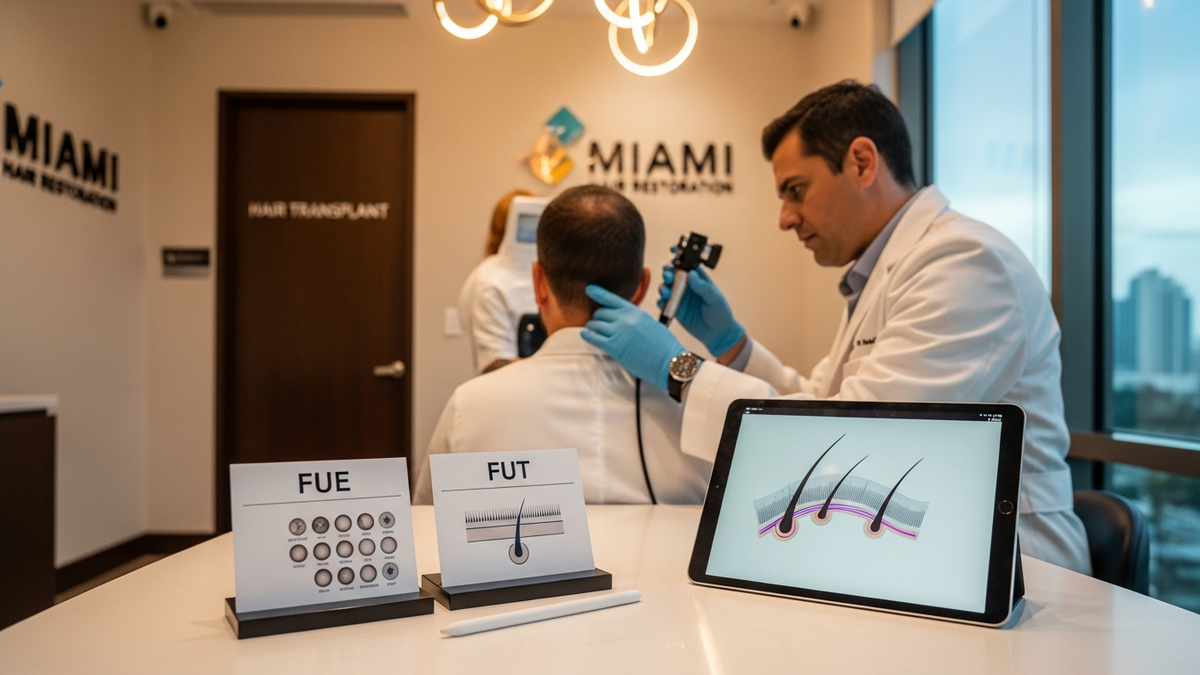
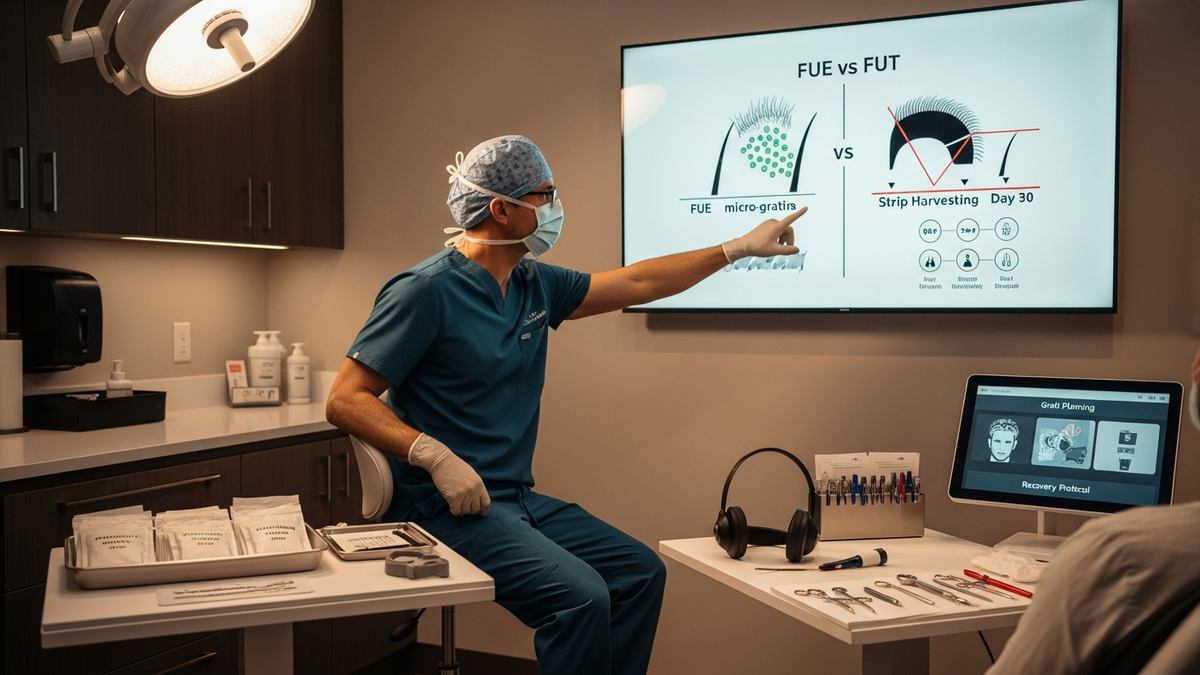
Two common surgical methods are FUE (follicular unit extraction) and FUT (follicular unit transplantation). Both can produce natural outcomes when planned and executed well, but they differ in how grafts are harvested and how scarring typically presents.
FUE (Follicular Unit Extraction)
With FUE, individual follicular units are extracted—commonly using small punches—then implanted in the target area. Many patients prefer FUE because it may allow shorter hairstyles during recovery and can result in less linear scarring compared with FUT.
When evaluating a clinic, ask about extraction workflow, punch size philosophy, and how grafts are handled between extraction and implantation. If you want a broader overview of services, explore hair transplant options and typical service pathways.
FUT (Follicular Unit Transplantation / “Strip” Method)
With FUT, a strip of scalp containing hair follicles is removed and then dissected into follicular units for implantation. FUT can be beneficial in certain donor conditions and may support efficient graft harvesting for some patients.
Ask how the clinic evaluates whether FUT is appropriate for your donor characteristics and how they minimize tension during closure to support better scar quality.
How your surgeon decides between FUE and FUT
There’s no one-size-fits-all answer. A skilled surgeon will consider:
- Your donor density and scalp laxity
- Your hair-loss pattern and likely future progression
- Desired coverage goals (hairline restoration vs crown density)
- Personal preferences (e.g., hairstyle flexibility)
- Graft planning to preserve long-term donor capacity
In practice, many patients do best with a tailored plan—sometimes combining approaches to balance donor protection and aesthetic goals.
How to Choose the Right Hair Implant Surgeon
Choosing a hair implant surgeon is one of the highest-impact decisions you’ll make in your hair restoration journey. The “best” surgeon is the one who matches your anatomy, goals, and risk profile—and who can explain their plan clearly.
Use a surgeon-selection checklist
- Confirm credentials and specialization: Look for board certification and training relevant to surgical precision and aesthetic outcomes.
- Ask who performs key steps: In high-quality practices, the surgeon typically leads or directly oversees critical stages—especially incision planning, graft placement, and hairline design.
- Review before-and-after results carefully: Evaluate similar hair-loss patterns, lighting conditions, and time since surgery.
- Discuss candidacy and expectations: A trustworthy surgeon will explain what’s realistic for your stage of hair loss.
- Ask about graft survival protections: Request details on handling, timing, and implantation workflow.
- Understand post-op protocols: Clarify meds, wound care, shampoo timing, activity restrictions, and follow-up schedule.
- Plan for the future: Good planning accounts for progressive hair loss so you don’t “over-harvest” early.
Why head-and-neck surgical expertise can matter
Hair transplantation is scalp surgery, but it also shares a broader surgical principle: precision in anatomy-adjacent planning. Surgeons with strong head-and-neck backgrounds often bring meticulous attention to tissue handling, aesthetic subunits, and functional considerations.
For example, Dr. Hootan Zandifar focuses on cosmetic and reconstructive surgery of the head and neck, with a reputation for natural-looking results and patient education. His approach underscores the value of careful planning and honest guidance—qualities that are equally important in hair restoration.
Clinical Candidacy: Who Is a Good Candidate?
Hair transplantation can be life-changing, but it’s not suitable for everyone. A hair implant surgeon should evaluate both current hair loss and future risk to design a safe, sustainable plan.
Common factors that support candidacy
- Stable or slowly progressing hair loss (often after medical stabilization)
- Adequate donor supply with good follicle quality
- Realistic aesthetic goals aligned with your hair pattern
- Good scalp health (no uncontrolled inflammatory conditions)
- Willingness to follow aftercare and attend follow-ups
Reasons someone may need a different plan
- Insufficient donor density to meet desired coverage
- Rapidly progressing loss without medical stabilization
- Scalp conditions that require treatment before surgery
- Expectations that exceed safe surgical limits
At TestBiz Hair Clinic, a premium hair transplant clinic offering FUE and FUT procedures with state-of-the-art technology, the emphasis is on matching technique to patient needs and protecting long-term donor value.
The Consultation: What to Expect (and What to Ask)
Your first consultation is where you learn whether the clinic’s process aligns with your goals. A strong hair implant surgeon will create a clear plan and show you how they arrived at it.
Typical consultation components
- Medical history review: Medications, prior surgeries, bleeding risk, and scalp issues.
- Scalp examination: Donor assessment and target-zone mapping.
- Hair-loss pattern analysis: Frontal, mid-scalp, crown, and density considerations.
- Design and discussion: Hairline shape, angle, density distribution, and coverage strategy.
- Procedure selection: FUE vs FUT, or hybrid options based on your anatomy.
- Timeline planning: Surgery day logistics and recovery milestones.
Questions worth bringing
- What is my expected graft count range, and why?
- How will you protect long-term donor reserves?
- What does natural hairline design mean in my case?
- What risks are most relevant for me (infection, scarring, shock loss)?
- What is your follow-up schedule, and who handles post-op concerns?
- How will you manage expectations around shedding and regrowth?

How the Surgery Works: Step-by-Step Overview
Every clinic has its own workflow, but most hair transplant surgeries follow a structured sequence. Below is a practical “what happens when” overview you can discuss with your surgeon.
Step 1: Preparation and marking
On the day of surgery, the surgeon typically marks incision sites and confirms the planned hairline and distribution. This step matters because hair direction and spacing strongly influence the natural look.
Step 2: Graft harvesting
For FUE, follicular units are extracted individually. For FUT, the surgeon removes a strip and then dissects it into graft units. Both methods require meticulous handling to support graft viability.
Step 3: Graft implantation
Implantation involves creating recipient sites and placing grafts with appropriate angle, depth, and density. The frontal hairline often receives the most detailed attention because it’s the most visible zone.
Step 4: Immediate post-op care
After surgery, you’ll receive wound care instructions, medication guidance, and activity restrictions. A clear plan for washing, bandage care, and follow-up appointments is essential.
Recovery Timeline: What You’ll Feel and See
Recovery is as important as surgery. Most patients experience a predictable sequence—initial healing, temporary shedding, and gradual regrowth. Your surgeon should explain each phase so you don’t mistake normal changes for complications.
Early healing (first days to 2 weeks)
- Discomfort and tightness: Mild soreness is common; pain control should follow your surgeon’s instructions.
- Swelling: Some patients notice swelling around the forehead/scalp area.
- Cropping and scabbing: Recipient sites often form small crusts that fall off during healing.
- Washing protocol: You’ll follow a specific shampoo and gentle cleaning plan.
Shedding phase (around weeks 2–12)
Many patients experience temporary shedding of transplanted hairs. This can be alarming, but it’s often part of the normal hair cycle reset. Your surgeon should set expectations so you know what’s typical.
Regrowth (around months 3–12+)
New growth usually becomes more noticeable over time. Density and thickness continue improving beyond the first year as the follicles mature.
Activity and lifestyle considerations
- Avoid strenuous exercise during the early healing window as instructed.
- Protect the scalp from sun exposure and friction during healing.
- Follow medication guidance carefully—especially if you’re using hair-loss therapies.
Risks, Side Effects, and How Surgeons Reduce Them
All surgery carries risk. A responsible hair implant surgeon discusses risks upfront and explains how their protocols reduce them.
Common risks patients should understand
- Infection: Reduced through sterile technique and post-op hygiene instructions.
- Bleeding and inflammation: Managed with careful surgical technique and follow-up.
- Scarring: Varies by method; FUT typically creates a linear scar, while FUE creates small punch scars.
- Shock loss: Temporary shedding in surrounding hairs may occur.
- Uneven density or hair direction: Usually linked to planning and placement technique.
Evidence-based context (with citations)
Hair transplantation outcomes depend on surgical technique, graft handling, and patient selection. According to the American Academy of Dermatology, hair transplant surgery is an option for certain types of hair loss, and results vary based on individual factors.
Also, the International Society of Hair Restoration Surgery (ISHRS) provides education and standards that emphasize responsible practice and patient safety across hair restoration.
Statistic context: In a review of hair transplant outcomes, a commonly cited clinical consideration is that graft survival and density can vary across patients and techniques; professional societies stress careful planning and technique to maximize viable outcomes. For a patient-friendly overview of variability and expectations, the AAD’s hair transplant guidance is a useful starting point.
What “Natural-Looking” Results Really Mean
Natural results are not just about “having hair.” They’re about how hair behaves visually—hairline softness, density distribution, and how hair direction mimics your existing growth pattern.
Hairline design and density mapping
A skilled surgeon designs the hairline to match your facial proportions and age-related expectations. The goal is typically a gradual transition from native to transplanted hair rather than a stark boundary.
Graft angle and spacing
Angle and spacing influence how light reflects off the scalp. Too steep or too dense early on can look unnatural, while poor spacing can under-deliver coverage.
Long-term planning for progressive loss
One of the most important “why” factors is future progression. If your hair loss continues, your transplant may need rebalancing later. Good planning helps protect donor supply so you can adapt over time.
Cost Considerations: What You Should (and Shouldn’t) Optimize
Pricing can vary widely. While cost matters, the safest way to evaluate value is to compare clinical quality: planning rigor, surgeon involvement, post-op protocols, and evidence-based practice—not just graft-per-dollar claims.
Questions to ask about pricing
- Is the surgeon personally involved in critical steps?
- What’s included in the price (meds, follow-ups, post-op care)?
- How are graft counts assessed and documented?
- What happens if you need additional sessions later?
At premium clinics like TestBiz Hair Clinic, transparency and individualized planning are central to the care model—especially for patients worldwide seeking consistent, state-of-the-art results.
How Hair Restoration Connects to Broader Facial Aesthetics
Hairline restoration is part of facial aesthetics. Surgeons who work across head and neck anatomy often bring experience in natural-looking tissue outcomes and patient-centered education.
Why patient education matters
Dr. Hootan Zandifar, MD, FACS—owner and lead facial plastic and reconstructive surgeon—emphasizes honest, trustworthy, and compassionate care, with strong commitment to patient education and natural-looking solutions. While hair restoration is distinct from facial surgery, the shared principle is that informed patients make better decisions.
If you’re exploring other aesthetic procedures as part of a holistic confidence plan, you may also find these related resources relevant:
- Blepharoplasty for upper and lower eyelid concerns
- Facelift options for facial rejuvenation
- eyebrow transplant considerations when eyebrow thinning affects facial balance
These links are provided for context only; your hair restoration plan should be created by a hair-focused surgical team.
Local Context: Finding a Hair Implant Surgeon in Los Angeles
If you’re in Los Angeles, you may have access to a range of hair restoration specialists. In a city with many options, the best strategy is to evaluate the clinic’s surgical process and outcomes—not just proximity.
What to look for in the Los Angeles area
- Clear documentation of planning and graft strategy
- Evidence-based follow-up and post-op support
- Surgeon-led planning for hairline and density decisions
- Transparent risk discussion and realistic outcome ranges
Dr. Hootan Zandifar is based in Beverly Hills, CA, and serves patients with an educational, natural-results philosophy. For hair restoration, you should still confirm that the clinic specializes in hair transplantation and can support your specific FUE/FUT goals.
Note: If you’re also considering functional nasal procedures for breathing concerns, you may find relevant information through Septoplasty and related structural guidance. While this is not hair restoration, it reflects the same surgical emphasis on anatomy and patient education.
Action Plan: Your Next 7 Days Before You Book
Use this short action plan to make your search more efficient and more accurate. A hair implant surgeon should feel like a partner in your decision-making—not a salesperson.
Day 1–2: Gather your records
- Take standardized photos of your hairline and scalp in consistent lighting.
- List current medications and any prior treatments for hair loss.
- Note family history and when you first noticed thinning.
Day 3–4: Shortlist clinics
- Look for clinics offering FUE and/or FUT with clear protocols.
- Confirm who performs the key surgical steps.
- Check if the surgeon provides direct planning and follow-up.
Day 5–6: Prepare your questions
- Ask about hairline design, graft handling, and donor protection.
- Request a recovery timeline and activity restrictions.
- Discuss risks most relevant to your scalp and health profile.
Day 7: Choose based on clarity and safety
Select the hair implant surgeon who provides a coherent plan, realistic expectations, and a supportive post-op pathway. If you feel pressured, unclear, or rushed, keep looking.
Ready to Take the Next Step?
If you’re considering a hair transplant, the best time to get clarity is now. A high-quality consultation can help you understand candidacy, decide between FUE and FUT, and create a long-term plan for density and donor safety.
FlowGeniQ Digest recommends requesting a consultation checklist and asking who will lead planning and placement. If you want to explore hair restoration services and common procedural pathways, review hair transplant options as a starting point.
Frequently Asked Questions
How do I know if I’m a good candidate for a hair transplant?
A good candidate typically has adequate donor supply, a hair-loss pattern that can be responsibly planned, and the willingness to follow aftercare. A qualified hair implant surgeon should evaluate scalp health, progression risk, and realistic coverage goals during consultation.
What’s the difference between FUE and FUT?
FUE extracts follicular units individually, while FUT removes a strip that is then dissected into grafts. Your surgeon may recommend one method—or a hybrid—based on donor characteristics, desired density, and scar preferences.
Will transplanted hair shed before regrowth?
Many patients experience temporary shedding after transplantation as part of the hair cycle reset. This shedding is often normal, but it should be discussed in advance so you can distinguish expected changes from potential complications.
How long does recovery take?
Early healing commonly spans days to a couple of weeks, with scabbing and gentle washing protocols during that time. Most patients can return to routine activities gradually, while visible regrowth typically continues over months.
What risks should I ask my hair implant surgeon about?
Ask about infection prevention, scarring expectations, shock loss, and the steps taken to protect graft survival. A transparent surgeon will explain how their protocols reduce risks and how follow-up support works if concerns arise.
External Sources (for further reading)
- According to the American Academy of Dermatology, hair transplant surgery can be an option for certain types of hair loss, and results vary by individual factors.
- According to the International Society of Hair Restoration Surgery (ISHRS), professional education and standards emphasize responsible practice and patient safety in hair restoration.
Professional Disclaimer
This content is provided for general educational purposes only by FlowGeniQ Digest. It is not a substitute for professional advice, diagnosis, or treatment. Readers are advised to consult qualified professionals for personalized recommendations.
Medical Information Disclaimer
This content is provided for general educational purposes only by FlowGeniQ Digest. It is not a substitute for professional advice, diagnosis, or treatment. Readers are advised to consult qualified professionals for personalized recommendations.