Author: Dr. Hootan Zandifar, FUEsion Hair Clinics
Updated for clarity and patient education (no date-based claims).
Hair loss can feel personal—especially when you’re trying to choose the right clinic and the right technique. If you’re searching for a hair transplant in denver colorado, you’re likely comparing options like traditional FUE, strip surgery, and non-surgical approaches. At FUEsion Hair Clinics, we focus on one clear goal: delivering natural-looking, permanent hair restoration with a surgical process designed for precision at every micro-step.
In this guide, we’ll explain who hair transplant surgery is for, how our AI & AR-assisted FUEsion technique works, what recovery typically looks like in Denver, and how to prepare for a consultation so you can make confident decisions. We’ll also share practical next steps—so you know exactly what to ask when you meet our surgeons.
Why choose a Denver hair transplant clinic?
Denver is a unique market—many people want hair restoration that fits an active lifestyle (work, sports, travel) and a climate where recovery comfort matters. While the biology of hair growth doesn’t change by city, your experience can: communication speed, surgical planning quality, post-procedure support, and realistic expectations all affect outcomes.
When you’re evaluating a clinic for a hair transplant in Denver Colorado, we recommend looking beyond marketing and focusing on three essentials:
- Surgeon-led planning and execution: the most important decisions (donor assessment, hairline design, graft strategy) should be made at a surgical standard.
- Technique-level precision: graft survival depends on careful extraction geometry, handling, and implantation details—not just graft count.
- Transparent expectations: you should know your likely timeline, coverage plan, and what “full results” means for your pattern of hair loss.
If you’d like to explore our approach, you can learn more about Advanced Hair Transplant Technology and how precision planning supports outcomes.
What is an AI & AR-assisted FUE hair transplant?
A modern hair transplant typically uses Follicular Unit Extraction (FUE), where individual follicular units are removed from the donor area and placed into thinning or bald regions. What differentiates a premium FUE program is how carefully the clinic optimizes each stage—before, during, and after extraction.
How the FUEsion technique is designed for precision
At FUEsion Hair Clinics, our proprietary FUEsion Hair Transplant technique uses AI & AR-assisted protocols to elevate the micro-details across the entire procedure—from initial follicle assessment and extraction geometry to graft processing and implantation depth and angle.
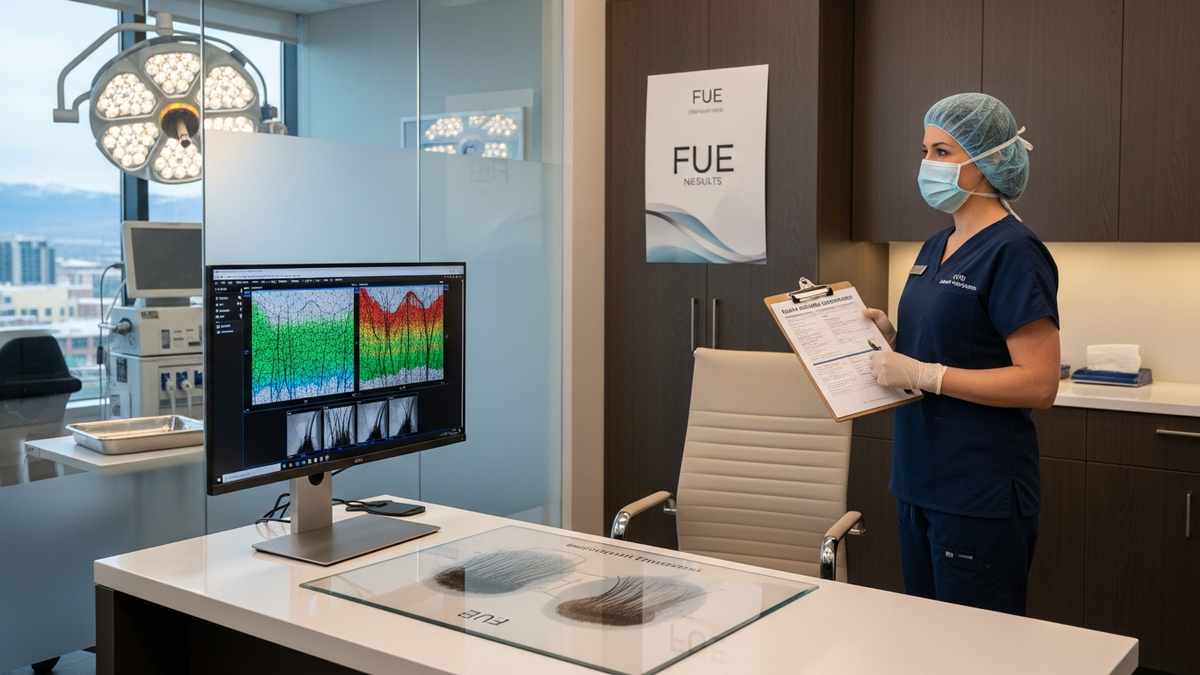
To support the planning process, we use structured donor analysis to understand follicle characteristics and create an extraction map that aims to maximize yield while preserving donor appearance.
Why graft survival depends on more than “number of grafts”
People often ask, “How many grafts do I need?” It matters—but it’s not the only factor. Graft survival and long-term density depend on:
- Extraction quality: minimizing unnecessary trauma and transection risk.
- Immediate graft handling: preservation protocols that protect viability.
- Implantation precision: correct angle, depth, and distribution for natural growth.
- Hairline artistry: designing a hairline that matches your facial structure and age-appropriate aesthetics.
According to NIH-indexed dermatology literature, outcomes in hair transplantation are influenced by surgical technique and the handling of grafts (searchable via PubMed/NIH resources). For individualized guidance, your surgeon should assess your donor and pattern of loss in person.
Who is a good candidate for hair transplant surgery in Denver?
Hair transplant candidacy depends on donor availability, pattern stability, and realistic goals. In general, the best candidates have a clear pattern of hair loss and sufficient donor density to support long-term coverage.
Common candidates for a Denver hair transplant
- Male pattern baldness (Norwood II–VII): when donor density remains strong enough for extraction and redistribution.
- Receding hairline: especially temple recession where hairline refinement can restore balance.
- Crown thinning: when distribution strategy can improve overall density.
- Scarring hair loss (selected cases): only after careful evaluation by a specialist team.
Female hair transplant considerations
Women can benefit from surgical restoration too, but the aesthetic goals and density patterns often differ. At FUEsion Hair Clinics, we use specialized protocols for female hair transplantation—supporting natural fullness while respecting the delicacy of facial framing.
If you’re exploring options, you can review Female Hair Transplant to understand how planning may differ from male pattern loss.
When non-surgical restoration may be a better first step
Not everyone needs surgery immediately. Early-to-mid stage hair loss, certain shedding patterns, and people who want to avoid incisions may explore non-surgical restoration. Our Non-surgical Hair Restoration option is designed for targeted follicular stimulation and can sometimes be combined with surgical approaches for enhanced results.
Hair transplant procedure: what happens from start to finish?
If you’re preparing for a hair transplant in denver colorado, it helps to understand the workflow so you can plan time, recovery, and follow-up expectations. Below is a clear overview of the process we follow at FUEsion Hair Clinics.
Step 1: Advanced donor assessment and extraction mapping
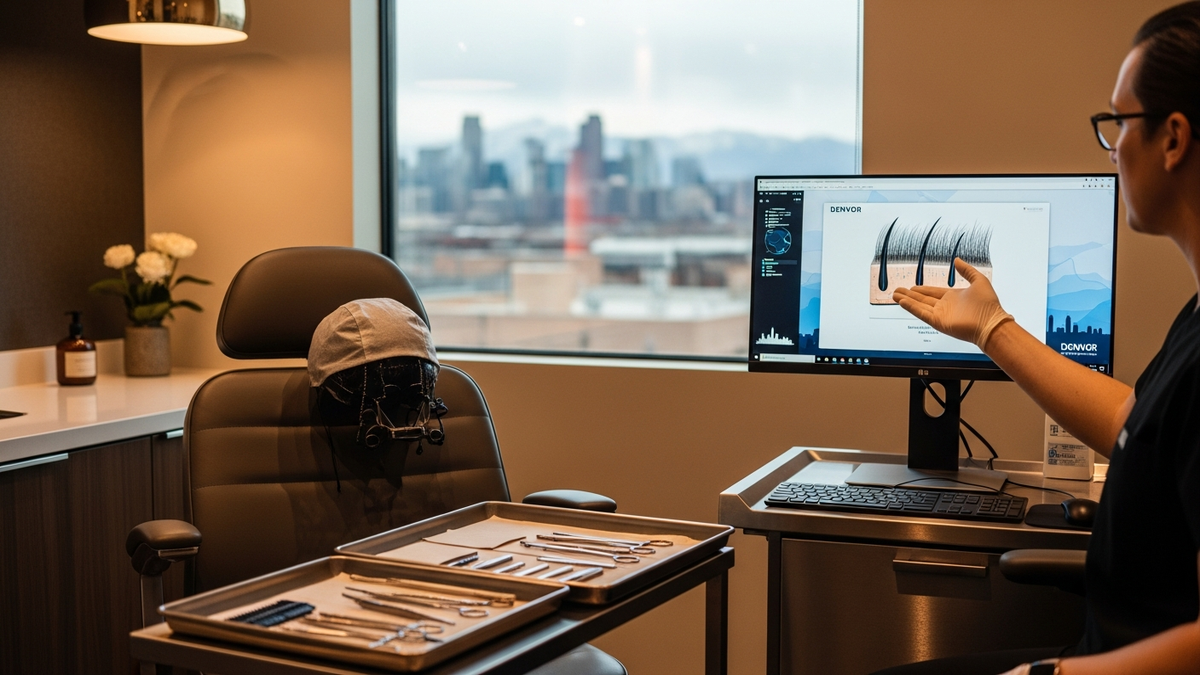
Before any extraction begins, our surgeons perform a detailed microscopic analysis of your donor region. We assess follicle density, calibre, curvature, and grouping to create an extraction map aimed at maximizing yield while preserving the donor area’s natural appearance.
Step 2: Precision extraction with custom-calibrated tools
Using micro-punch tools calibrated to your follicular characteristics, grafts are extracted with minimal trauma to surrounding tissue. The goal is to reduce preventable risks such as transection and unnecessary handling stress.
Step 3: Advanced graft processing and preservation
Extracted grafts are processed under strict protocol to support viability. This includes careful handling to protect the grafts from unnecessary delays and stress.
Step 4: Implantation with natural angle, depth, and distribution
Implantation is where artistry meets science. Our surgeons plan implantation depth and angle to match the way hair grows naturally, supporting a believable density transition and a hairline that looks like it always belonged there.
Step 5: Post-procedure support and milestone guidance
After your procedure, you’ll receive guidance for washing, activity adjustments, and follow-up. Your timeline typically includes early shedding, visible improvement starting around 6 months, and full results often between 12–18 months—depending on your pattern and graft plan.
For a deeper overview of the surgical pathway, visit Hair Transplant Procedure.
How long does recovery take in Denver?
Recovery time can vary by graft count, your healing response, and your job demands. However, most patients plan for a return to routine activities within days, with more visible changes unfolding over months.
Typical timeline (general guidance)
- Days 1–3: initial healing and gentle care (you’ll follow surgeon-specific instructions).
- Days 5–7: many patients return to work depending on comfort and job visibility.
- Weeks 2–4: continued healing with ongoing scalp management.
- Months 3–6: early growth becomes more noticeable for many patients.
- Months 12–18: full density and maturation period.
Denver-specific practical tips
Because Denver patients often consider outdoor activity and travel, we recommend planning your first two weeks with “low friction” logistics:
- Arrange rides and schedule flexibility: especially if your workplace requires face-to-face meetings.
- Follow scalp care precisely: hydration and cleansing instructions matter for comfort.
- Protect your scalp: avoid unnecessary sun exposure and follow your surgeon’s guidance for headwear.
Hair transplant outcomes: what “natural” should look like
Natural results aren’t just about coverage—they’re about how hair behaves visually. Your final look should blend into your existing hair, match your hairline age, and support appropriate density transitions.
What we design during planning
- Hairline shape: designed to fit facial proportions and your desired aesthetic.
- Temple refinement: addressing recession while preserving natural curvature.
- Distribution strategy: balancing front hairline and mid-scalp/crown density.
- Future-proofing: considering how your pattern may progress so results remain coherent.
If you want to review real patient transformations, explore Hair Transplant Before and After.
Non-surgical options and complementary treatments
Even if you ultimately choose surgery, many patients benefit from a comprehensive plan that may include non-surgical restoration—especially for early-stage thinning or as a supportive approach.
InFuze Non-Surgical Restoration basics
Our InFuze non-surgical system is built to support follicular stimulation through targeted delivery protocols and a biological environment designed for regrowth. It’s commonly considered for patients who prefer to avoid surgery at first or who want to enhance their overall results.
To understand whether non-surgical restoration fits your goals, review Non-surgical Hair Restoration and bring your questions to your consultation.
Advanced hair transplant technology: what makes it different?
When patients search for hair transplant in denver colorado, they often want to understand what “advanced technology” truly means. In our case, it’s not about gimmicks—it’s about surgical consistency and better planning.
AI & AR-assisted planning and execution
Our approach is designed to support precision at each stage: mapping, extraction geometry, graft handling protocols, and implantation depth/angle. This helps standardize quality and supports more predictable outcomes.
Free planning tools to help you visualize possibilities
Before you commit to anything, we offer free tools to help you understand your potential transformation. You can try the AI Result Simulator and explore your graft estimate with the Cost Calculator.
Cost of a hair transplant in Denver Colorado: what influences pricing?
Pricing varies based on your graft needs, the complexity of your hair loss pattern, and the level of surgical planning required. Instead of guessing, we recommend starting with an estimate tool and then confirming your exact graft count with a surgeon.
Key drivers of hair transplant cost
- Graft count: more coverage typically requires more grafts.
- Hair loss pattern: crown thinning, diffuse thinning, and hairline recession can require different strategies.
- Donor quality: donor density and follicle characteristics affect yield and planning.
- Procedure complexity: density goals and distribution can change operative time.
How we keep cost transparent
We believe in clarity. Your consultation should include a precise plan, a recommended graft count, and a full cost breakdown. If you want to explore a preliminary estimate first, start with the Cost Calculator.
What to ask during your consultation in Denver
A great consultation should leave you with answers you can act on. Here are high-value questions to bring to your visit—especially if you’re comparing clinics for a hair transplant in denver colorado.
Questions that help you evaluate quality
- Who performs the key steps? Extraction and implantation should be surgeon-led with clear protocol.
- How will you design my hairline? Ask how the surgeon accounts for your facial proportions and age.
- What is my likely timeline? You should understand shedding, regrowth, and full maturation.
- What happens if my pattern progresses? Ask about future-proofing and distribution strategy.
- What support do I receive post-procedure? Confirm follow-up, care instructions, and milestone check-ins.
Links that can help you prepare
It’s also smart to review our guarantees and clinic standards ahead of time. You can read about FUEsion Assurance/Warranty and explore FUEsion Hair Clinics Locations.
Other restoration options: beards and eyebrows
Hair restoration isn’t limited to the scalp. Many Denver patients also look for facial hair enhancement and eyebrow shaping when they want a more complete, balanced look.
Beard transplant
If you want a fuller, more defined beard, our surgical approach can help create natural density. Learn more about Beard Transplant.
Eyebrow transplant
Eyebrows require careful angle and distribution planning to match facial expression. Our protocol supports subtle, natural-looking shaping—see Eyebrow Transplant.
Local trust: choosing the right team for your hair restoration goals
Choosing a clinic is about more than distance. It’s about trust, surgical standards, and how you feel during planning. At FUEsion Hair Clinics, we’re committed to a patient-first experience with surgeon-led precision and clear education.
For patients in the Denver region, you may also see our clinic presence referenced under FUEsion Hair Clinics Denver. We encourage you to confirm your appointment details directly during booking so you receive the right plan for your case.
Statistics and evidence that matter
Hair restoration decisions can be emotional, so we focus on evidence-based guidance and transparent expectations.
Graft survival and technique importance
While individual results vary, surgical literature and clinical reviews consistently emphasize that technique affects graft survival and final density. According to NIH/PubMed-indexed review articles, factors such as transection rates, handling, and implantation parameters are associated with outcomes.
Hair loss is common—so you’re not alone
Hair loss affects a large portion of the population. For context, the American Academy of Dermatology (AAD) notes that male pattern hair loss is common and increases with age (see AAD patient resources at www.aad.org).
What “full results” typically means
Many clinics counsel patients that meaningful growth begins around 6 months and full maturation can take longer. This timeline aligns with general hair cycle behavior described in dermatology education resources, including those summarized in academic and professional references (e.g., NIH dermatology resources accessible via NIH).
Frequently Asked Questions
How do I know if I’m a good candidate for a hair transplant in Denver Colorado?
A strong candidate typically has sufficient donor density and a stable enough pattern of hair loss to support long-term coverage. During your consultation, our surgeons assess your donor region microscopically and map a distribution plan that matches your goals.
What is the typical recovery time after FUE hair transplant surgery?
Many patients can return to work within about 5–7 days, depending on comfort and job demands. You’ll receive specific post-procedure care instructions, and visible improvement usually continues for months as hair growth matures.
Will a hair transplant look natural, especially around the hairline?
Natural-looking results depend on hairline artistry and precise implantation angle, depth, and distribution. We design the hairline to complement your facial structure and aim for believable density transitions.
How does the AI & AR-assisted FUEsion technique help?
Our AI & AR-assisted protocols support precision planning and help standardize micro-details across the procedure, including extraction mapping and implantation parameters. The goal is to optimize surgical consistency for better patient outcomes.
Can I combine non-surgical restoration with surgery?
In some cases, a combined plan may support early-stage thinning or enhance overall density strategy. Your surgeon can recommend whether non-surgical restoration (such as InFuze) fits your pattern and timeline.
Ready to explore your options?
If you want a clear, surgeon-guided next step, we recommend starting with a consultation. You’ll receive a precise plan, recommended graft count, and a full cost breakdown—without obligation.
To learn more about our team philosophy, you can read About FUEsion Hair Clinics.
Book Consultation
Tell us what you’re hoping to restore and we’ll guide you toward the right surgical or non-surgical pathway.
Professional Disclaimer
This content is provided for general educational purposes only by FUEsion Hair Clinics. It is not a substitute for professional advice, diagnosis, or treatment. Readers are advised to consult qualified professionals for personalized recommendations.
Medical Information Disclaimer
This content is provided for general educational purposes only by FUEsion Hair Clinics. It is not a substitute for professional advice, diagnosis, or treatment. Readers are advised to consult qualified professionals for personalized recommendations.