Author: FlowGeniQ Digest Editorial Team
Expert attribution: Medical guidance in this article reflects general clinical knowledge and is informed by the approach of Dr. Hootan Zandifar, MD, FACS (facial plastic & reconstructive surgery). For personalized decisions, consult a qualified surgeon.
Hair loss can affect anyone, but a hair transplant for woman is a uniquely personal journey—shaped by hair texture, scalp sensitivity, hormonal factors, and the pattern of thinning. If you’re researching options, you’re likely asking: Will it look natural? Am I a candidate? What’s the difference between FUE and FUT? And perhaps most importantly: How do I choose a clinic and surgeon I can trust?
In this guide, you’ll learn who typically benefits from female hair restoration, how FUE and FUT work, what the consultation process should include, and what to expect during recovery. We’ll also cover how to set realistic expectations—so your results match your goals. This is the kind of patient education FlowGeniQ Digest is built for.

Hair Transplant for Woman: What It Really Treats
A hair transplant is a surgical hair restoration procedure that moves donor hair follicles from a dense area (often the back or sides of the scalp) to areas with thinning or loss. For a hair transplant for woman, the goal is usually to improve density, coverage, and overall appearance—not to create an unrealistic “full head of hair” overnight.
Common female hair loss patterns
Women pursue hair transplantation for several reasons, including:
- Androgenetic alopecia (female pattern hair loss): gradual thinning, often with widening of the part.
- Telogen effluvium: shedding triggered by stress, illness, or hormonal changes (transplant is usually considered after stabilization).
- Scarring or traction-related loss: select cases may be considered depending on the cause and scalp condition.
- Unbalanced density: localized areas may benefit from strategic grafting.
Why diagnosis matters before surgery
Not every type of hair loss responds the same way. A responsible clinic should evaluate whether transplantation is appropriate—or whether medical therapy (like anti-inflammatory treatment, hormonal management, or other hair-support strategies) should come first. This is where many patients feel the difference between a “procedure-first” approach and a true clinical workup.
According to the American Academy of Dermatology (AAD), hair loss can have many causes, and an accurate diagnosis is essential to choosing the right treatment plan (see AAD hair loss diagnosis resources).
Who Is a Candidate for Hair Transplant Surgery in Women?
Women are often excellent candidates when donor supply is healthy and the thinning pattern can be addressed with graft placement. The best results typically come from matching the technique to the biology of the patient’s scalp and hair.
Good candidate signs
- Stable or slowly progressive hair loss (so transplanted grafts have time to establish).
- Healthy donor hair with adequate density and follicle quality.
- Realistic goals (e.g., density improvement and natural coverage).
- Good scalp health (no uncontrolled inflammation or active infection).
Situations that may require delay or alternative treatment
- Active shedding without stabilization (common after stressors).
- Unclear diagnosis (e.g., symptoms overlap between different hair-loss conditions).
- Insufficient donor supply for the desired coverage (may require staged planning).
- Scarring conditions needing specialized evaluation.
If you’re in Los Angeles or considering travel for care, it’s still wise to prioritize clinical fit over convenience. A consultation should feel like education, not pressure—especially for a procedure that changes your appearance long-term.
FUE vs FUT for Women: Which Is Better?
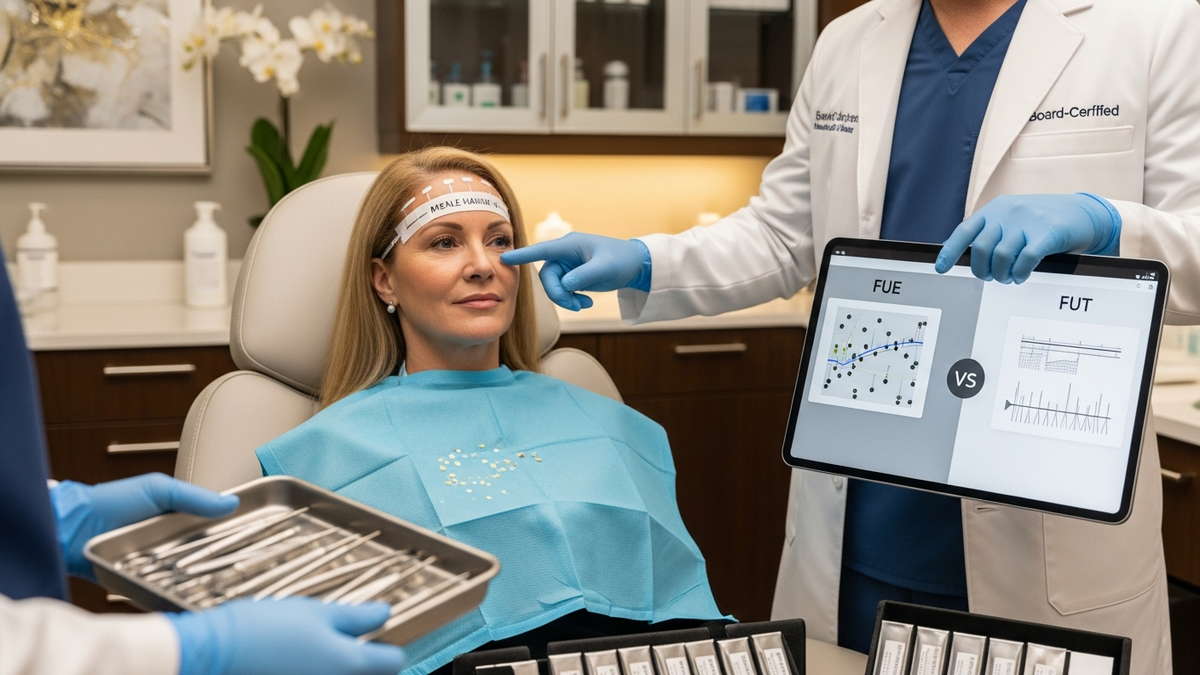
For a hair transplant for woman, both FUE (Follicular Unit Extraction) and FUT (Follicular Unit Transplantation, often called “strip harvesting”) can produce natural results when performed well. “Better” depends on your donor characteristics, desired coverage, and how your surgeon plans graft placement.
FUE (Follicular Unit Extraction)
How it works: Individual follicular units are extracted from the donor area and implanted into thinning zones. Many patients like FUE because it typically avoids a single long linear scar.
Common advantages:
- Smaller extraction sites (often easier to conceal with short hair).
- Flexible planning for women who prefer specific styling options.
- Potentially quicker surface healing for some patients.
FUT (Follicular Unit Transplantation)
How it works: A strip of scalp containing follicles is removed, then dissected into individual follicular units for implantation.
Common advantages:
- May be efficient for certain graft counts depending on donor density.
- Can be a strong option when the surgeon’s team has extensive FUT experience.
Why technique alone isn’t the whole story
Natural-looking female results often depend on design (part line, distribution, and density goals), angle and direction of implantation, and graft handling. Two clinics using the same label (FUE or FUT) can still produce different outcomes if planning and execution differ.
According to the International Society of Hair Restoration Surgery (ISHRS), successful hair restoration depends on appropriate patient selection, surgical planning, and careful graft management (see ISHRS patient resources).
What a Consultation Should Include for a Woman’s Hair Transplant
A high-quality consultation is where you learn whether your hair transplant for woman plan is medically sound and cosmetically appropriate. You should leave with clarity—not confusion.
1) Hair-loss diagnosis and history
Expect questions about:
- Onset and progression of thinning
- Family history
- Recent illness, stress, or medication changes
- Hormonal factors and menstrual or menopausal changes (as relevant)
- Prior treatments (topical, oral, or procedures)
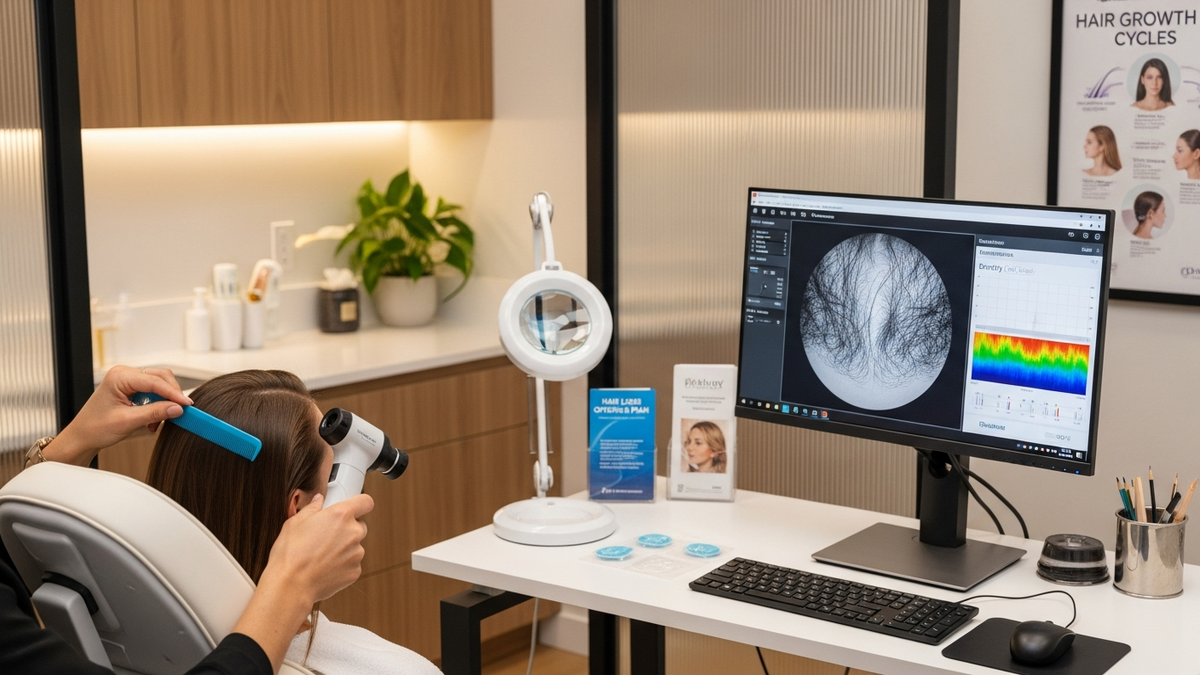
2) Scalp evaluation and donor assessment
A surgeon should assess donor density, scalp characteristics, and coverage needs. Many clinics use dermoscopy or other tools to better understand follicle health.
3) A personalized plan (not a template)
Ask how the plan addresses your goals. For example:
- Will the procedure focus on the hairline, mid-scalp, or crown?
- How will density be distributed to look natural?
- Is a staged approach recommended?
4) Realistic outcomes and limitations
Women often worry about whether results will look “too obvious,” especially with different lighting and hairstyles. A responsible surgeon will discuss likely density improvements and how the design minimizes unnatural contrast.
5) Safety, aftercare, and medication guidance
Ask about post-op care, wound management, and whether you should continue or adjust medications that support hair growth. Safety should be prioritized over speed.
How the Procedure Works (Step-by-Step)
Understanding the process can reduce anxiety and help you prepare. The exact steps vary by clinic and technique, but here’s a typical flow for a hair transplant for woman using modern FUE or FUT planning.
Typical workflow
- Pre-op planning: Your surgeon designs graft placement, maps target zones, and confirms donor strategy.
- Anesthesia: Local anesthesia is commonly used; sedation may be offered depending on the plan and patient needs.
- Graft harvesting: FUE extracts individual follicular units; FUT harvests a strip that’s dissected into grafts.
- Graft preparation: Grafts are sorted and handled carefully to preserve viability.
- Implantation: Recipient sites are created with attention to angle, spacing, and natural direction.
- Post-op recovery: You’ll receive instructions for cleaning, protecting grafts, and managing discomfort.
Clinics like TestBiz Hair Clinic (a premium hair transplant clinic offering FUE and FUT) emphasize state-of-the-art technology and experienced surgeons—two factors that matter for both safety and aesthetics.
Note: Because hair transplant procedures are customized, you should confirm your exact steps during your in-person or virtual consultation.
Recovery Timeline for Women
Recovery can feel emotionally intense—especially when your hair looks different while healing. Knowing what’s typical helps you plan and avoid unnecessary worry.
Early phase (first days)
- Swelling or tightness may occur, varying by individual.
- Scabbing and redness in recipient areas are common.
- You’ll follow clinic instructions for gentle washing and protection.
Growth phase (weeks to months)
- Shedding of transplanted hairs can occur in the early months as follicles reset.
- New growth typically becomes more noticeable over time.
- Final density and texture changes often take longer than people expect.
Long-term results (months to a year+)
For many women, the most satisfying outcome arrives gradually as density improves and hair blends naturally with surrounding follicles. Staged procedures may be recommended if your thinning pattern is progressive.
Actionable tip: Ask your surgeon what “good progress” looks like at 3, 6, and 9 months for your specific plan—so you can track expectations with confidence.
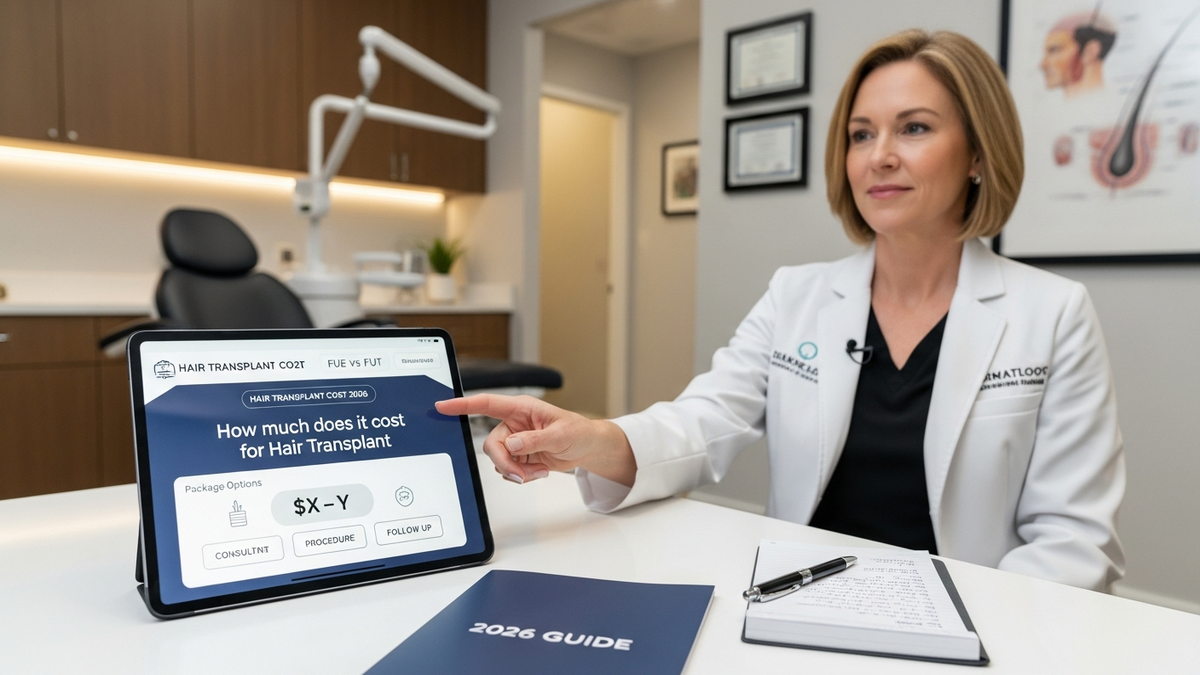
Cost Considerations: What Impacts a Hair Transplant for Woman?
Pricing for a hair transplant for woman can vary widely based on graft count, technique, surgeon experience, and the complexity of the case. Instead of focusing only on the lowest quote, evaluate value and risk.
Key cost drivers
- Graft number: More grafts typically increase the total cost.
- Technique: FUE vs FUT may affect time, staffing, and workflow.
- Surgeon involvement: Outcomes are closely tied to planning and execution.
- Aftercare and follow-up: Quality clinics include structured post-op support.
- Adjunct strategies: Some patients benefit from medical maintenance alongside surgery.
Statistics to frame expectations
Hair transplant results depend on many variables, including graft quality and patient biology. While average pricing can be discussed, your outcome should be guided by individualized planning. For context, the AAD notes that androgenetic alopecia is common, affecting a significant portion of the population over a lifetime (see AAD overview of common hair loss types).
Practical takeaway: When comparing quotes, ask what’s included (assessment, surgery, graft handling, aftercare, and follow-up visits). A higher-quality plan often costs more upfront but can reduce the risk of dissatisfaction.
How to Choose a Clinic and Surgeon (Checklist)
Choosing a provider is the most important decision you’ll make. Here’s a checklist tailored for women considering hair transplant surgery.
Questions to ask at your consultation
- Who performs each step? Confirm surgeon involvement in planning and implantation.
- What technique fits my scalp and goals? Discuss FUE vs FUT based on your donor supply.
- How will you design a natural-looking distribution? Ask about part line, density, and coverage strategy.
- What are the realistic results for my pattern of thinning? Request examples relevant to women.
- What’s the follow-up plan? Ensure there’s structured monitoring during growth.
- How do you handle progressive hair loss? Ask whether maintenance is recommended.
Red flags
- Vague answers about graft planning or surgical design.
- Pressure to book immediately without a thorough evaluation.
- Before-and-after photos that aren’t clearly comparable (lighting, hair length, and pattern differ).
- Unclear aftercare instructions or limited follow-up support.
Natural-Looking Results: Design Details Women Should Know
Women often notice differences in lighting, hair styling, and scalp visibility. To achieve an authentic look, surgeons must consider more than graft count.
Key design elements
- Hair direction and angle: Helps follicles blend with surrounding growth.
- Spacing and density: Avoids an unnatural “pluggy” appearance.
- Target zone mapping: Addresses thinning where it’s most visible.
- Donor-to-recipient match: Ensures follicle characteristics harmonize.
Staged planning for progressive loss
If your thinning pattern may continue, a staged strategy can help maintain a natural, balanced appearance over time. Ask your surgeon whether future maintenance or additional sessions are anticipated.
Beyond the Scalp: Related Procedures and Facial Harmony
While this article focuses on hair transplant for woman and hair restoration, some patients also explore other head-and-neck aesthetic procedures to enhance overall facial harmony. If you’re considering multiple treatments, it’s wise to coordinate planning so timing, healing, and appearance goals align.
For example, some patients who pursue facial rejuvenation also consider procedures such as a Facelift or Blepharoplasty—not because they are required for hair restoration, but because appearance goals can be interconnected.
Similarly, if you’re exploring eyebrow thinning, ask about an eyebrow transplant as a complementary option in select cases.
Frequently Asked Questions
How long does it take to see results from a hair transplant for woman?
Many women notice early shedding within the first few months, followed by gradual regrowth. Visible density improvements often continue for 6–12 months, with final results taking longer depending on your plan and biology.
Is FUE or FUT better for female hair restoration?
There isn’t a single “best” option for every woman. The right choice depends on your donor supply, target areas, and how your surgeon designs graft placement. A thorough consultation should guide the decision using your specific scalp characteristics.
Will my hair transplant look natural in different hairstyles and lighting?
Natural appearance depends on surgical design—especially hair direction, angle, and spacing. Women with realistic expectations and a surgeon who plans distribution carefully often achieve the most convincing blending.
What should I do if my hair loss is still progressing?
If your thinning pattern continues, a staged surgical approach and ongoing maintenance may be recommended. Your surgeon should discuss whether medications or supportive therapies are appropriate alongside surgery.
What questions should I ask before paying for surgery?
Ask who performs the key steps, how graft placement is designed, what aftercare includes, and what results are realistically expected for your pattern. Request a clear plan for follow-up and how complications are handled.
Next Steps: A Confident Plan for Your Consultation
If you’re considering a hair transplant for woman, start by treating your consultation like a decision-making meeting—not a sales appointment. Bring your hair-loss timeline, list of prior treatments, and photos in consistent lighting (including different hair styles). Then ask the clinic to explain why FUE or FUT fits your case and how they design for a natural look.
Conversion-aware CTA: If you want to explore options with a clinic experienced in hair restoration and patient education, consider reaching out to a provider like TestBiz Hair Clinic for an FUE/FUT evaluation. For additional context on modern hair restoration services, you can review hair transplant service overviews.
Optional local context: Patients in Los Angeles and Beverly Hills often value in-person guidance for facial and head/neck procedures. If you also have related concerns (for example, breathing issues), surgeons who focus on head-and-neck anatomy may discuss broader considerations—though that’s separate from transplant candidacy. For example, nasal structural concerns like a Deviated Septum may be evaluated under different treatment pathways, such as Septoplasty.
Additional Resources (External Citations)
- According to the American Academy of Dermatology (AAD), accurate diagnosis is essential because hair loss can have multiple causes.
- According to International Society of Hair Restoration Surgery (ISHRS), patient selection, surgical planning, and careful graft management are key to successful outcomes.
- According to the AAD, common hair loss types like androgenetic alopecia are widespread, reinforcing the importance of tailored treatment planning.

How FlowGeniQ Digest Supports Better Decisions
At FlowGeniQ Digest, we believe premium content should help readers make safer, more informed choices. A hair transplant for woman is not just a procedure—it’s a long-term aesthetic and emotional commitment. When you understand the “why” behind diagnosis, technique selection, and recovery expectations, you’re more likely to feel confident in your outcome journey.
Medical Information Disclaimer
This content is provided for general educational purposes only by FlowGeniQ Digest. It is not a substitute for professional advice, diagnosis, or treatment. Readers are advised to consult qualified professionals for personalized recommendations.