FlowGeniQ Digest education playbook for Beauties & Beasts Med Spa (Littleton, Colorado)
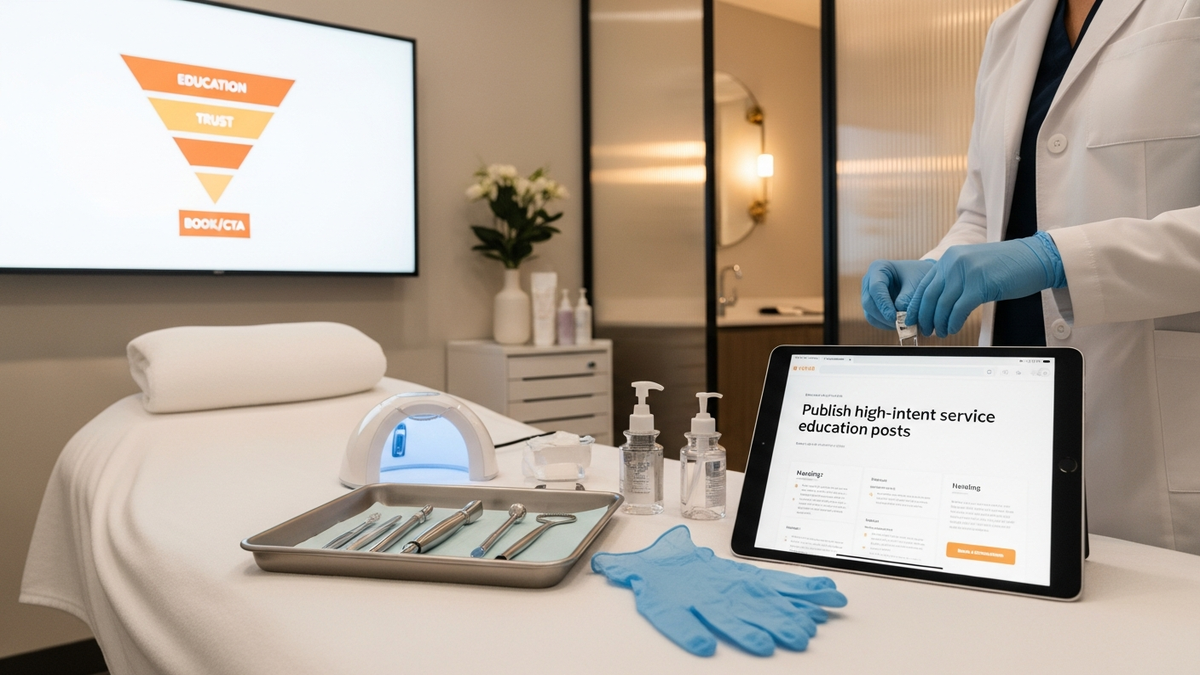
Goal: help you publish high-intent service education posts that attract the right visitors and move them toward “Book a Consultation.”
When people search online for a cosmetic or wellness service, they’re rarely browsing for fun. They’re usually comparing options, trying to understand timelines, and looking for reassurance about safety and results. That’s why the best marketing strategy for a med spa is not generic blogging—it’s to publish high-intent service education posts that directly answer the questions your ideal patients ask before they book.
In this guide, we’ll show you how to plan, write, and structure service education content for injectables, skin rejuvenation, and hair restoration—using the real client intent patterns of Beauties & Beasts Med Spa in Littleton, Colorado. You’ll learn what to cover, how to organize it, and how to measure whether it’s working, so your content becomes a conversion asset, not just an SEO checkbox.

What “high-intent service education” really means
High-intent service education content is written for people who are already leaning toward a decision. They may not have chosen a provider yet, but they’re asking practical questions like: “How long does Botox last?” “Are fillers painful?” “How many sessions are needed?” “What does recovery look like?”
For med spa audiences, that intent clusters around four themes:
- Results: when they start, how long they last, and what “normal” looks like
- Safety: suitability by skin type, risk awareness, and professional oversight
- Comfort & downtime: what to expect during and after treatment
- Process: how the visit works, what happens first, and how plans are personalized
When you write to these themes, you’re not “selling”—you’re reducing uncertainty. And uncertainty is the biggest blocker between a visitor and a booking.
Why education posts convert better than promotional posts
Promotional content tells people what you offer. Education content helps people decide if they want what you offer—with confidence. In practice, that means your pages earn trust signals that search engines and readers both value: clear answers, structured information, and credible expertise.
According to the American Academy of Dermatology (AAD), patient education and professional guidance are key to safe and effective skin care decisions (see external citation below). When you translate that principle into blog structure—timelines, expectations, and aftercare—you create content that feels “clinically grounded,” not marketing fluff.
Audience blueprint: who you’re writing for at Beauties & Beasts
Beauties & Beasts Med Spa serves adults in Littleton, Colorado seeking minimally invasive cosmetic improvements, preventative anti-aging, skin health support, and hair restoration options. The primary provider is Dr. Danielle Sanders DNP-C, and the content should reflect that clinical credibility.
Primary patient intent patterns
Based on your most common service questions, your high-intent education posts should address:
- Injectables: “How long does Botox last?” “Are fillers painful?” “What areas can be treated?” “When will I see results?”
- Skin rejuvenation: “How many sessions are needed?” “What is recovery like?” “Can it treat acne scars?” “Does it help pigmentation?”
- Laser and hair removal: “How many sessions are needed?” plus prep and maintenance guidance
- Hair restoration: “What are non-surgical options?” and “How does the process work?”
- Wellness: “What supports energy and metabolic health?” (positioned as complementary care)
Local relevance (Littleton, Colorado)
Local searchers want to confirm two things: that the provider is legitimate and that the plan fits their lifestyle and timeline. Add Littleton, Colorado context in a natural way—such as scheduling considerations, typical recovery expectations, and how follow-up is handled.
Keyword strategy: build around questions, not just services
To publish high-intent service education posts, your keyword approach should be question-first. Use your service categories as “pillars,” then build individual posts around specific queries.
Turn service categories into post angles
Use these examples as starting points:
- Injectables: “How long does Botox last?” “When will I see filler results?” “What areas can be treated with neuromodulators?”
- Dermal and Lip Fillers: pain, swelling, bruising, and natural-looking contouring
- Skin rejuvenation: microneedling vs. RF microneedling, chemical peels for pigmentation, and session counts
- Hair regrowth: non-surgical options explained, candidacy, and expectations for regrowth timelines
- Laser hair removal: hair growth cycles and why multiple sessions are required
Use semantic variants to stay natural
Instead of repeating the same phrase, rotate through related terms: “aesthetic medicine,” “medical spa,” “skin rejuvenation,” “injectables,” “facial aesthetics,” “non-surgical cosmetic procedures,” and “personalized treatment plans.” This helps you meet SEO goals while keeping language patient-friendly.
Content structure that maximizes conversions
High-intent service education posts should read like a consultation outline. The structure below is designed to reduce friction from first scroll to booking.
Recommended H2/H3 outline (copy-ready)
1) Start with the answer (first 100 words)
Open with the core question and a clear, non-alarming answer. For example: timelines, typical outcomes, and what affects results. This ensures the right visitors immediately feel “this is for me.”
2) Explain the “how” (process and preparation)
Describe what happens during the visit, what you evaluate, and how the plan is customized.
3) Cover comfort and downtime
Be specific: mild swelling, bruising, numbing options, and when patients can return to daily life.
4) Provide timelines and session counts
Use ranges, note variability, and explain what will be monitored at follow-ups.
5) Address safety and candidacy
Explain who may benefit and who should ask more questions first (for example, skin sensitivity or medical considerations). Avoid diagnosing—use “may,” “often,” and “your provider will assess.”
6) Add aftercare guidance
Give actionable, simple steps patients can follow right away.
7) End with next steps + CTA
Invite readers to book an appointment to personalize the plan.
Service education examples you can adapt
Below are “mini-templates” you can use to write multiple publish high-intent service education posts across Beauties & Beasts Med Spa service lines.
Injectables post template: results, timing, and comfort
One of the highest-intent topics is neuromodulators and wrinkle reduction. In your post, explain what the treatment does at a high level, then answer the patient’s practical question: when they’ll see changes and what affects duration.
For example, you can reference Botox, Dysport, Letybo, & Jeuveau and then outline:
- What areas are commonly treated (forehead, glabella, crow’s feet)
- When improvement typically develops (gradually over days)
- Common aftercare expectations (avoid strenuous activity for a short window as advised)
- How to maintain results (timing follow-ups)
Fillers post template: expectations for swelling and natural-looking contour
Patients often worry about discomfort and whether results will look “overdone.” Address both directly. When you discuss lip and facial volume, emphasize individualized planning and conservative approaches when appropriate.
To support internal navigation, include a single link to your service page with the exact anchor text: Dermal and Lip Fillers.
Then cover:
- What “temporary” means (how fillers naturally break down over time)
- What swelling or bruising may occur and how mild side effects typically resolve
- How the provider chooses product type and placement for facial harmony
- What patients can do before and after the appointment to support comfort
Skin rejuvenation post template: microneedling, laser, and pigmentation
For skin rejuvenation content, structure your post around a clear patient goal: acne scars, pigmentation, texture, or anti-aging. Then explain the technology in patient-friendly terms.
Include a section that answers:
- How many sessions are commonly recommended
- What recovery looks like
- Whether it’s suitable for different skin concerns (with provider assessment)
Body contouring post template: non-surgical expectations and session planning
Body contouring searchers often want to know if results are permanent, how many sessions are required, and whether surgery is avoidable. Use a balanced tone: explain outcomes, variability, and realistic goals.
For internal linking, use the exact anchor and URL once: Body Contouring.
Then outline:
- Who is typically a candidate (provider evaluation)
- What to expect during sessions
- How treatment intervals are scheduled
- Maintenance and lifestyle factors that support results
Hair restoration template: explain candidacy and timelines
Hair regrowth content is high-intent because readers are searching for a solution they can trust. Explain the process step-by-step and clarify what non-surgical options can and cannot do.
Include a single internal link for navigational support: Hair Regrowth Solutions.
Then cover:
- Common causes of hair thinning (general education, not diagnosis)
- What evaluation looks like at a consultation
- How regrowth timelines are typically discussed (gradual change)
- Maintenance and follow-up planning
Brand trust: show your “why” using a consistent voice
Patients want reassurance that they’re dealing with professionals. Mention that Beauties & Beasts Med Spa focuses on personalized care plans, modern technology, and natural-looking results—grounded by Dr. Danielle Sanders DNP-C expertise.
In addition, a subtle brand trust anchor can help. For example, you can mention your brand name Beauties & Beasts and link to your homepage once using the exact required anchor text: Beauties and Beasts.
How to write “answer-first” sections that feel like a consultation
Readers don’t want to hunt. They want clarity. Use this approach:
- Answer in one sentence, then expand with 2–4 practical details
- Use patient-friendly language (define terms like “recovery” and “downtime”)
- Include variability (“results vary by individual and treatment area”)
- Connect to next steps (what they should do after reading)
At the end of each major section, add a “What to do next” mini prompt. This improves dwell time and gives readers a mental path toward booking.
FAQ section that captures high-intent queries
Use FAQs to capture long-tail searches and to provide quick reassurance. For best results, keep questions concise and answers short but helpful. Below is a ready-to-paste FAQ set aligned with common beautician and medical spa intent patterns.
Frequently Asked Questions
How long does Botox, Dysport, Letybo, & Jeuveau last?
Results commonly last several months, though the exact duration varies by individual and the treatment area. Many patients notice gradual improvement over the first several days and plan follow-ups based on how their goals evolve.
Are dermal and lip fillers painful?
Most patients experience mild discomfort, and providers may use numbing options to improve comfort. Mild swelling or bruising can occur after treatment, typically resolving within a short period.
How many microneedling or laser sessions are usually needed?
The number of sessions depends on the skin concern and the desired outcome. Your provider will assess your goals and skin type to recommend a personalized plan and realistic timeline.
Will hair disappear after one laser hair removal session?
Usually not. Laser hair removal requires multiple treatments because hair grows in cycles, and sessions are timed to target hair during active growth phases.
Is body contouring non-surgical, and is it permanent?
Many body contouring options are non-surgical, and results can be long-lasting, but they are not always permanent in the way surgery is. Maintenance and lifestyle factors can influence how outcomes evolve over time.
Stats and evidence to strengthen credibility
Education posts perform better when they’re grounded in trustworthy sources. Here are a few evidence-backed points you can reference (and cite) to build authority:
- Sun protection is foundational for skin health and aging: The AAD emphasizes that daily sunscreen use helps protect against harmful UV radiation that contributes to premature skin aging. According to the American Academy of Dermatology (AAD), sunscreen can help prevent sunburn and reduce risk from UV exposure (American Academy of Dermatology—Sun Protection).
- Hair removal requires multiple sessions due to growth cycles: Laser hair removal works best when hair follicles are targeted during active growth. According to the U.S. Food and Drug Administration (FDA), the timing of treatments matters because hair growth cycles affect results (FDA—Laser Hair Removal).
- Medical oversight matters for cosmetic safety: Professional guidance helps patients understand risks, contraindications, and aftercare. The AAD provides guidance on safe cosmetic dermatology practices and patient education (American Academy of Dermatology—Cosmetic Procedures).
Note: These references support educational context. Your post should still remain non-diagnostic and encourage consultation for personalized recommendations.
Internal linking plan: keep users moving toward booking
High-intent service education posts should guide readers to the most relevant service pages without overwhelming them. Use 2–3 internal links total per article, each anchored to a clear topic.
For this article, Beauties & Beasts Med Spa internal links are designed to support major service pathways:
- Neuromodulators and wrinkle reduction: Botox, Dysport, Letybo, & Jeuveau
- Volume and contouring: Dermal and Lip Fillers
- Non-surgical body goals: Body Contouring
- Hair regrowth evaluation: Hair Regrowth Solutions
- Brand trust reinforcement: Beauties and Beasts
Additionally, consider linking to related education posts on topics like “facial rejuvenation without surgery” and “professional skincare vs. at-home routines” to deepen topical authority.
How to measure whether your education posts are working
After you publish, track performance with a simple conversion mindset:
- Organic performance: impressions and clicks for high-intent queries (search console)
- Engagement: time on page, scroll depth, and FAQ interaction
- Conversion signals: consultation page visits and form starts
- Content gaps: which questions show up in “People Also Ask,” then add new FAQs
At FlowGeniQ Digest, we recommend iterating every 60–90 days: update timelines, add clarifying language, and improve internal linking based on what visitors actually do.
Action checklist: publish your next high-intent post
Use this quick checklist before publishing:
- Pick one primary question (e.g., “How long does Botox last?”).
- Answer it in the first 100 words, then expand with details.
- Include process steps: what happens at consult, during treatment, and aftercare.
- Add comfort/downtime expectations using clear, non-alarming language.
- Use a targeted FAQ section with 3–5 questions.
- Link to 2–3 relevant service pages with descriptive anchors.
- End with a single CTA that invites booking for personalization.
CTA: next step toward a personalized plan
Ready to turn education into results? If you’re in Littleton, Colorado and want a clinician-led plan tailored to your goals, schedule your visit.
Professional Disclaimer
This content is provided for general educational purposes only by FlowGeniQ Digest. It is not a substitute for professional advice, diagnosis, or treatment. Readers are advised to consult qualified professionals for personalized recommendations.
Medical Information Disclaimer
This content is provided for general educational purposes only by FlowGeniQ Digest. It is not a substitute for professional advice, diagnosis, or treatment. Readers are advised to consult qualified professionals for personalized recommendations.